
Rail transit systems demand exceptional reliability, safety, and durability. Whether used in metro systems, high-speed trains, light rail vehicles, or freight transportation, every component must perform consistently under demanding operating conditions. From structural brackets and housings to axle boxes and precision shafts, manufacturing quality directly affects the safety and service life of the entire system.
As rail transit projects become increasingly complex, manufacturers are expected to provide customized components that meet strict dimensional, material, and performance requirements. Understanding the manufacturing processes behind these parts helps engineers, procurement teams, and OEMs select the most suitable production solution.
1.Common Rail Transit Components and Their Manufacturing Requirements
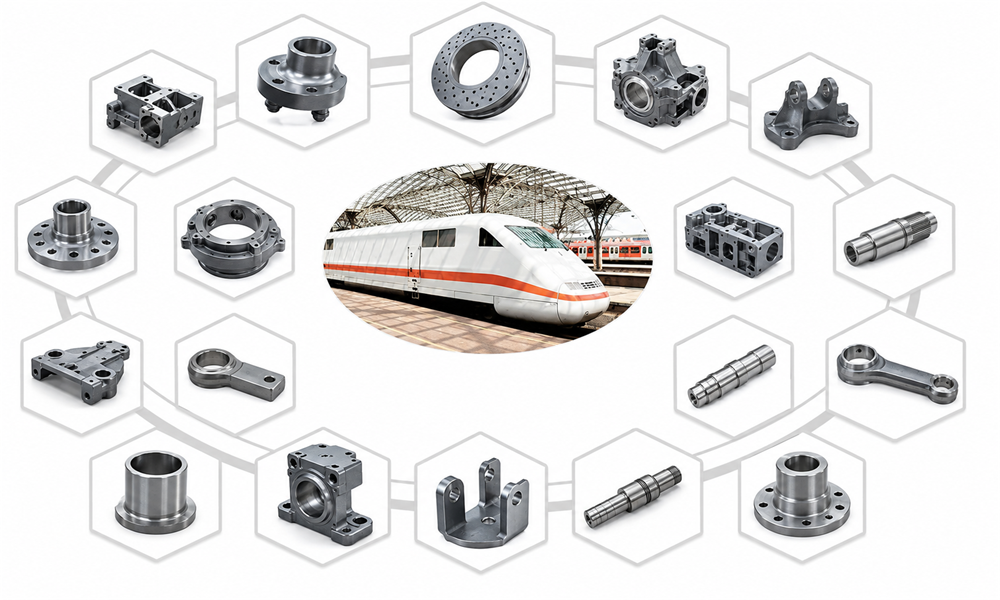
Rail transit equipment contains a wide variety of components, each serving a different function. Structural parts such as support brackets, mounting bases, housings, and equipment frames provide mechanical stability. Running and connection components, including axle boxes, brake discs, coupler assemblies, and bearing housings, are directly related to vehicle performance and operational safety. In addition, precision machined parts such as shafts, bushings, sleeves, pins, and connecting rods play a critical role in assembly accuracy and long-term reliability.
Because these components differ significantly in size, geometry, and functional requirements, manufacturers typically choose between two primary production routes: casting followed by CNC machining, or direct CNC machining.
(1)Manufacturing Route 1: Casting Followed by CNC Machining
For many large and structurally complex rail transit components, casting combined with CNC machining offers the most efficient and economical manufacturing solution.
Which Components Typically Use This Manufacturing Route?
Components such as axle boxes, brake discs, coupler bodies, center plates, bearing housings, and support bases often begin as castings. Casting allows manufacturers to create complex shapes, internal cavities, and reinforced structures while minimizing material waste and reducing production costs.

Why Is CNC Machining Required After Casting?
Although casting can produce the basic shape of a component, it cannot achieve the precision required for final assembly. Critical features such as bearing seats, mounting surfaces, alignment holes, threaded interfaces, and precision bores must be machined to meet engineering specifications.
CNC machining ensures dimensional accuracy, flatness, parallelism, coaxiality, and surface finish requirements. By combining casting with precision machining, manufacturers can achieve both cost efficiency and high-performance functionality.
Benefits of Casting Machining
The combination of casting and machining offers an ideal balance between complexity, strength, and precision. It allows manufacturers to produce large structural components efficiently while ensuring that critical functional surfaces meet strict tolerance requirements. As a result, this manufacturing route is widely used throughout the rail transit industry.
(2)Manufacturing Route 2: Direct CNC Machining
While casting is suitable for large structural components, many rail transit parts are manufactured directly from bar stock, plate material, or forged blanks through CNC machining.
Which Components Are Commonly Produced Through Direct Machining?
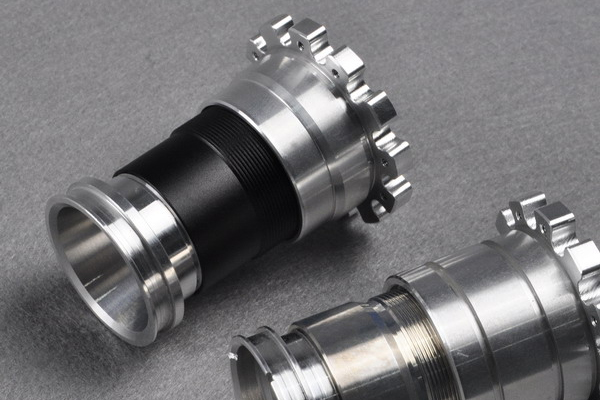
Typical examples include shafts, pins, bushings, sleeves, connecting rods, precision connectors, and various custom mechanical parts. These components generally require tighter tolerances and higher dimensional consistency than can be achieved through casting alone.
When Is Direct Machining the Better Choice?
Direct CNC machining is often preferred when parts require high precision, rapid development, or low-to-medium production volumes. Because no casting tooling is required, manufacturers can move directly from engineering drawings to production, making this approach highly flexible for customized and non-standard components.
Advantages of Direct CNC Machining
Modern CNC turning and milling equipment can produce highly accurate parts with excellent repeatability and surface quality. This process is particularly suitable for components with tight tolerances, complex geometries, and demanding assembly requirements. It also enables faster design modifications and shorter lead times, making it ideal for prototype and customized production projects.
2.Why Custom Manufacturing Is Critical in Rail Transit Projects
Unlike standard industrial products, rail transit components are often designed for specific vehicle platforms and operating environments. Different projects may require unique dimensions, mounting interfaces, material specifications, and performance characteristics. As a result, many components are manufactured according to customer drawings rather than standardized catalog designs.
Material selection is another key consideration. Depending on the application, manufacturers may use carbon steel, stainless steel, aluminum alloys, or alloy steels to achieve the required balance of strength, weight, corrosion resistance, and durability. Surface treatments such as anodizing, zinc plating, nickel plating, and powder coating can further improve environmental resistance and service life.
3.From Raw Material to Finished Product: A One-Stop Manufacturing Process
Successful rail transit projects require more than machining capability alone. A reliable manufacturing partner should be able to manage the entire production process from engineering review to final delivery.
The process typically begins with drawing review and Design for Manufacturability (DFM) analysis, helping identify opportunities to improve efficiency and reduce costs. Production then proceeds through material procurement, casting or machining operations, heat treatment, surface finishing, assembly, and final packaging.
By integrating these processes within a single supply chain, manufacturers can reduce lead times, improve communication, and maintain greater control over product quality throughout the project lifecycle.
4.Quality Control and Traceability in Rail Transit Manufacturing
Because rail transit components are often used in safety-critical applications, strict quality control procedures are essential. A comprehensive quality management system includes incoming material inspection, First Article Inspection (FAI), in-process inspection, and final inspection before shipment.
Traceability is equally important. Complete records of raw materials, production batches, machining operations, and inspection results help ensure transparency throughout the manufacturing process. Advanced inspection equipment such as Coordinate Measuring Machines (CMMs), surface roughness testers, and precision gauges are commonly used to verify dimensional accuracy and consistency.
These quality assurance measures help manufacturers maintain reliable performance across both prototype and mass-production projects.
5.How Euyik Supports Rail Transit Component Manufacturing
Euyik specializes in manufacturing precision, non-standard components for demanding industrial applications, including rail transportation equipment. Our production capabilities encompass five-axis CNC machining, CNC milling and turning, machining (CNC turning, CNC milling), Swiss turning, die casting, horizontal CNC milling, surface treatment, and complete supply chain support.
From complex cast machined structural components to high precision machined parts, we work closely with customers to transform technical drawings into reliable finished products. Supported by advanced manufacturing equipment, rigorous inspection procedures, ISO 9001 quality management practices, EN9100 standards, and complete production traceability, Euyik delivers customized solutions that help customers achieve their performance, quality, and delivery goals.
6.Conclusion
Rail transit components are manufactured using two primary production routes: casting followed by CNC machining and direct CNC machining. Each process offers distinct advantages depending on the size, geometry, and functional requirements of the component. By combining advanced manufacturing technologies, strict quality control, and comprehensive customization capabilities, manufacturers can produce reliable components that meet the demanding requirements of modern rail transit systems.
For companies seeking a trusted partner for custom rail transit components, Euyik provides one-stop manufacturing solutions designed to support projects from concept to production.